Compare

Short-Acting vs. Long-Acting Benzodiazepines: Why Duration Matters

Understand the differences between panic attack vs heart attack to manage symptoms and seek proper care when needed.

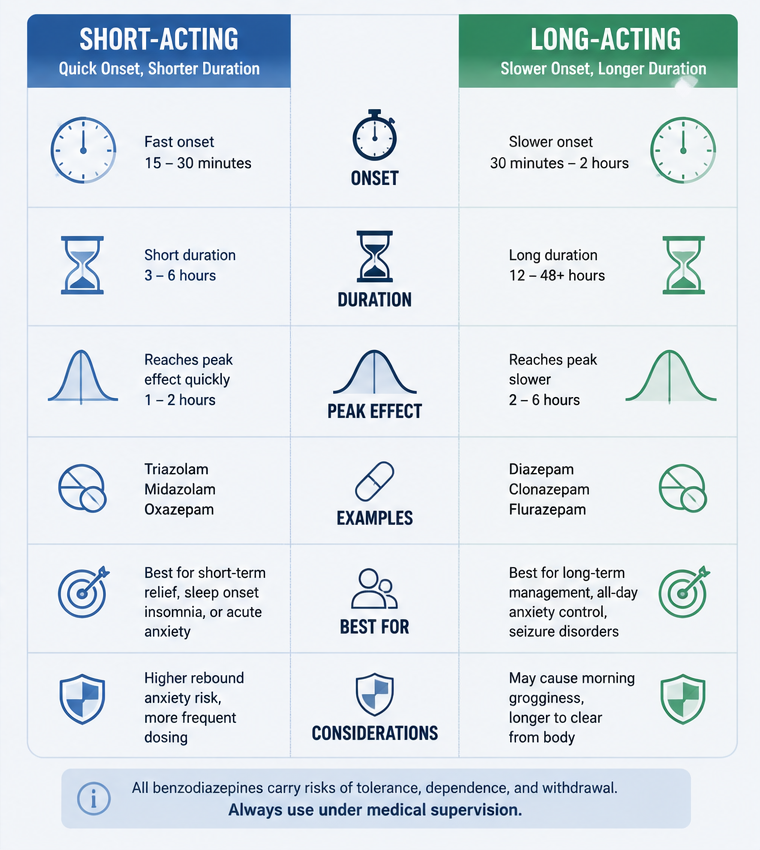
Short acting vs. long acting benzodiazepines isn’t just a technical distinction — it directly affects how a medication feels, how it’s used, and how risky it is to stop. Alprazolam sits firmly on the short-acting end of that spectrum, which matters more than most people realize.

What “short-acting” and “long-acting” actually mean

The terms refer to a drug’s half-life — how long it takes the body to clear half of it from the bloodstream. Short acting benzodiazepines like alprazolam have a half-life of roughly 11 hours; long-acting ones like diazepam (Valium) can have a half-life of over 48 hours once active metabolites are factored in.

MedicationTypeApprox. Half-Life
Alprazolam (Xanax)Short-acting~11 hours
Lorazepam (Ativan)Intermediate-acting~12 hours
Clonazepam (Klonopin)Long-acting~30–40 hours
Diazepam (Valium)Long-acting48+ hours (due to active metabolites)

Why this affects withdrawal risk

This is where short acting vs long acting benzodiazepines matters most. Short-acting medications leave the body faster, which means blood levels drop more sharply between doses — a pattern associated with more intense rebound anxiety and a higher risk of dependency with regular use. Long acting benzodiazepines taper off more gradually on their own, which is part of why they’re sometimes used specifically to help people transition off short-acting ones.

Important

Longer-acting doesn’t mean safer overall — long acting benzodiazepines carry their own risks, including next-day sedation and accumulation in the body with repeated dosing, particularly in older adults.

Why the choice matters clinically

  • Short acting: faster relief, better for acute, situational panic
  • Long acting: steadier coverage, sometimes preferred for generalized anxiety or tapering plans
  • Both carry dependency risk with regular use — duration changes the pattern, not whether the risk exists

Is a long acting benzodiazepine easier to stop than a short-acting one?

Often, yes — the gradual decline in blood levels can make withdrawal feel less abrupt, which is one reason some tapering plans temporarily switch a person to a longer-acting option under supervision.

Why is alprazolam prescribed at all if it has higher dependency risk?

Its speed is exactly what makes it useful for acute panic attacks — the tradeoff is managed through short-term prescribing rather than avoiding the medication altogether.

See the full medication comparison

This is one piece of a bigger picture — see how benzodiazepines compare to SSRIs and therapy too.